


$900.00
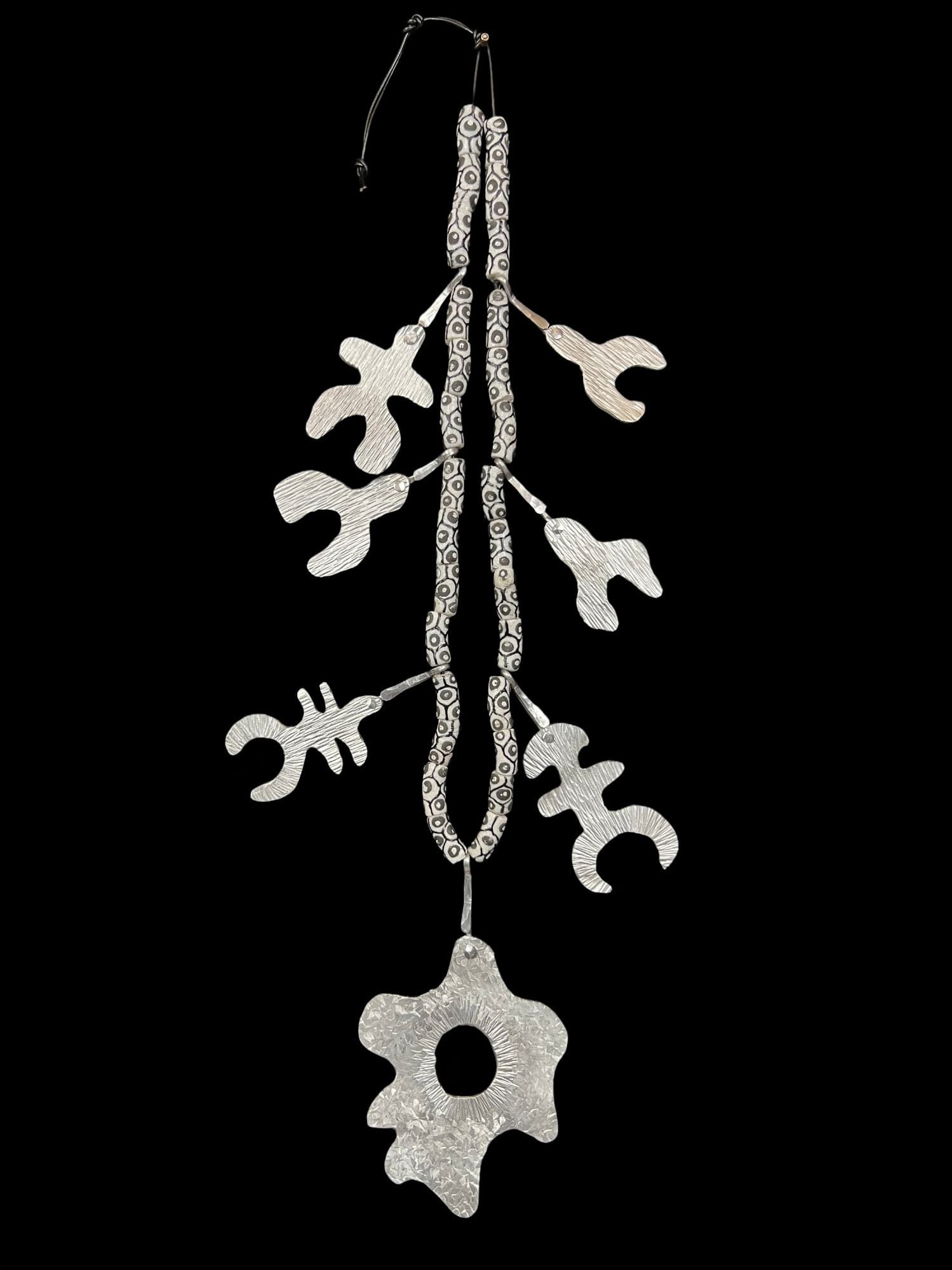
No. 7, Calabaza Agadez Series, 2024
Cold Forged Aluminum, Black & White Eye Krobo Beads, Aluminum Wire, Leather Cord
Length of Beaded Area 27″, Length of Leather Cord 46″
Pendants (from left to right)
No 1: 4″ H x 1.75″ W,
No 2: 3.5″ H x 1.75″ W,
No 3: 4.25″ H x 1.5″ W,
No 4: 6.25″ H x 3.625″ W,
No 5: 4.5″ H x 1.75″ W,
No 6: 3.5″ H x 1.5″ W,
No 7: 3.5″ H x 1.375″ W,
Stamped on back with artist’s mark.
1 in stock
This series of pendants is made from improvisational shapes cut freehand from decommissioned street signs.
After cutting, the aluminum is buffed with a wire wheel to remove the sign decal, adhesive, and any grime or slag from cutting, bringing the metal to a rich satin-like sheen. The edges of the shapes are further refined with a grinding wheel, belt sander and for tight details or holes, carbide grinding burrs.
Texture is applied by hand with a hammer— every single fine line of the texture is the result of an individual hammer blow. Even my smallest pieces typically require hundreds of swings of the hammer.
Pieces are joined with heavy wire from salvaged aluminum electrical cables which pierce the plate and are hammered into rivet heads.
Glass beads are fair trade sourced and are individually handmade from recycled glass in Ghana. Amber resin beads are fair trade and made by hand in Kenya. Bamboo coral is vintage stock.
This series began in pure play and technical experimentation, as much of my work does. I was looking for a way to combine my aluminum pendants with glass beads.
The first necklace in the series used aluminum shapes inspired by Kuba cloth from the Democratic Republic of the Congo and combined it with several shades of blue and greenish beads handmade from recycled glass in Ghana. The result bore a strong resemblance to Native American squash blossom necklaces, especially because the blue beads evoke turquoise. Strung on 1/8″ stainless steel rod, the first necklace rigidly holds it’s shape.
The later pieces are strung on leather cord to allow them to more closely fit the body. The cords are knotted rather than fixed with a clasp, allowing the length to be adjusted to fit a wider variety of both people and clothes. The beads are also handmade Ghanaian recycled glass beads, but patterned rather than monochrome. The shapes are loosely inspired by the form known as the Cross of Agadez made by Tuareg and Mauritanian metalsmiths.
While the exact origins of the squash blossom style necklace are lost to history, the earliest squash blossom necklaces are believed to have been created in the late 1870s or early 1880s after the native people of the area made contact with Spanish from Mexico.
Classic squash blossom necklaces are made up of three distinct components— plain round beads in silver or turquoise; beads with the floral petal motif that gives the style its name; and the crescent pendant at the bottom called the Naja.
Experts in Native American jewelry largely believe the eponymous squash blossom beads were influenced by the pomegranate design frequently used as decoration by the Spanish people, including on the buttons of soldiers’ uniforms. The Naja is also likely to have been adapted from the Spanish, who themselves picked it up from North Africans who affixed the talisman to their horses’ bridles to ward off the evil eye.
Materials and technique are my first principles in art, and I typically find the story, or meaning later. When I applied Berber shapes to a Native American necklace form, I had no idea that the central element of squash blossom necklaces was likely adapted from Berber traditions via the Spanish. But I do have an eye for form and a voracious appetite for detail, so it’s not surprising that some part of my brain connected the two visually.
Unlike precious metals, aluminum does not need to be polished. Pieces I applied this finish to over thirty years ago are as shiny as the day they were created.
What makes this finish truly special is the way it catches light and picks up colors from its environment. The hammer edge cuts very crisp grooves that shine much like a faceted stone. In blue light it can resemble mother of pearl, abalone or opal. In warmer tones it shimmers like amber, coral or agate.
Another advantage of Aluminum is its light weight. I can do large statement pieces which are comfortable to wear because they weight so little. The same work in silver or gold would send you straight to the chiropractor.
| Weight | .5 lbs |
|---|


