I’ve spent thirty years making mosaic art at institutional scale, commissioned by the American Museum of Natural History, documented in Smithsonian Magazine, The New York Times, and The Washington Post, and featured in a BBC documentary presented by Stephen Fry. I self-financed my magnum opus, the Anatomy Set in Stone series — a 22-work cycle spanning a 160-foot gallery, fourteen of them complete and the final eight to be made live in the museum’s Visible Studio. I have made it the way I have made everything: outside institutional structures, on my own terms. The Museum of Mosaic Environments is the next work.
On March 27, 2025, an executive order directed the Smithsonian’s American Women’s History Museum to “not recognize men as women in any respect” or lose federal funding. It was the opening move in a sustained assault on cultural institutions that has only escalated since.
I am a woman. I am also trans. Under the current administration, that distinction does not matter: any institution that shows my work, names my name, or acknowledges my existence does so at risk to its federal funding.
As of January 2026, I have spent ten years and $101,748.97 building Anatomy Set in Stone, a 22-work series of monumental mosaic works, as a touring museum exhibit. The work was ready. The institutions weren’t free to show it.
I will not wait to be erased. I decided to build.
The Museum of Mosaic Environments will open in Spain. Not because I am running from the United States. Because I am running toward a culture that does not require institutions to choose between their funding and their integrity.
The founding of this museum is not a retreat. It is an argument, made in stone and mortar, about what culture is for.
I am not building a museum because it was the obvious next step. I am building it because it needs to exist and no one else is going to build it.
The Museum of Mosaic Environments will be the world’s first institution dedicated to the complete global history of mosaic art, from the cone mosaics of ancient Mesopotamia to the monumental public works of the present day, spanning every major cultural tradition on earth. 30+ galleries. The School of Mosaic Environments. Artist residencies. A visible production studio where visitors watch the work being made in real time.
The school is not a weekend workshop program. It is a full vocational and artistic training ground, passing down five millennia of accumulated artistic knowledge, training artists in community based practice, and creating an entry point into public art production for people who would not otherwise have access to it. Students leave with a command of technique, professional career skills, and the business literacy to defend their work and their livelihoods in the market. The MME trains artists who can sustain themselves.
The historical galleries do not move original works. They move the experience of them through full-scale environmental reproduction, immersive spatial design, and scholarship that treats mosaic as what it has always been: fine art, not craft. This is an anti-colonial act. The fragments stay where they are. The knowledge travels.
I have spent ten years and over $100,000 of my own money building the proof of concept. Fourteen of the 22 monumental works in Anatomy Set in Stone are complete and ready for the founding collection, and the final eight will be made in front of visitors in the Visible Studio. The immersive exhibits Radio Ancestrale and The Sacred Body are complete and ready to show. I have a documented body of research on the structural conditions that made this institution necessary, a growing portion of it already published here on this site. I have a business model, a governance structure, and a location in active consideration.
What I am building next is the museum itself.
For ten years and $101,748.97, entirely self-financed through the sale of other work, I built the proof. Anatomy Set in Stone is a series of 22 monumental mosaic works, each one a life-sized anatomical figure rendered in hand-cut marble, averaging over 600 hours of labor each. The series has been documented in Smithsonian Magazine, The Washington Post, the National Library of Medicine’s Circulating Now, and exhibited at Carrie Haddad Gallery in Hudson, NY.
It was conceived as a touring museum exhibit. Covid shut the museums down. I doubled the size of the project. When they reopened, federal executive orders made the work politically toxic for any institution dependent on federal funding. I decided to build my own museum instead.
Anatomy Set in Stone will be the capstone exhibit of the Museum of Mosaic Environments, completed in the Visible Studio as live programming in the first years after opening, the final eight works made in front of an audience. The proof of concept becomes the founding collection.
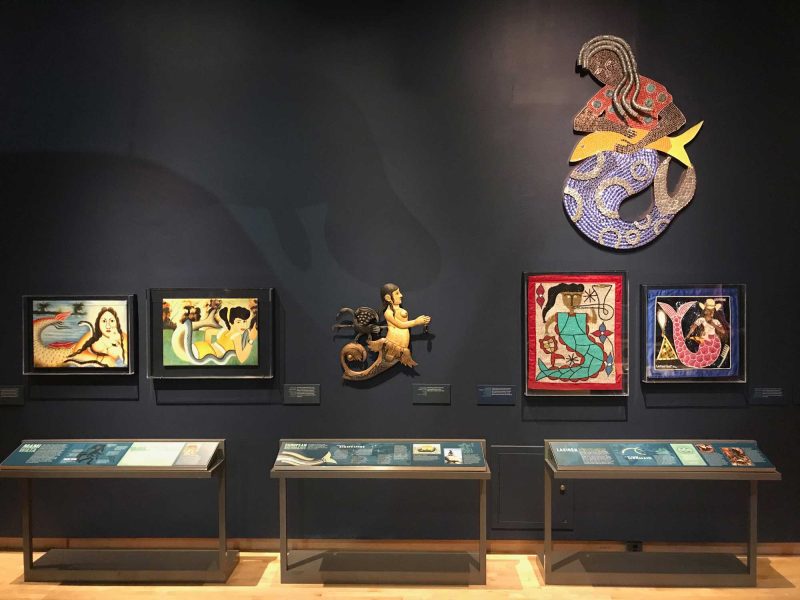
La Siren III was commissioned by the American Museum of Natural History for their traveling exhibition Mythic Creatures: Dragons, Unicorns & Mermaids, one of the most widely toured exhibitions in the museum’s history. The New York Times called the show “a brilliant curatorial idea.” The New Yorker gave it “a mythical ten.” The piece has been shown in museums across the country and appeared in the BBC documentary Fantastic Beasts: A Natural History, presented by Stephen Fry.
When one of the world’s great natural history museums needs a mosaic artist, this is the level of work they commission. La Siren III is the institutional credibility argument made material.
Old Glory is a ten-by-sixteen-foot American flag assembled from over 20,000 Budweiser bottle caps, commissioned for the Stagecoach Music Festival, one of the largest country music festivals in the United States. It is the largest bottle cap work I have made, designed to function simultaneously as monumental artwork and selfie destination for a crowd of tens of thousands.
Yes, the irony that I made an enormous American flag and now feel compelled to build my museum across the Atlantic fucking slays me. But Old Glory proves something the MME will need at scale: I can execute large-format, corporate-sponsored, crowd-activated public art. The pop-up experium model the MME is developing for revenue draws directly from this: bottle cap mosaics, pop culture subjects, festival and brand activation at scale.
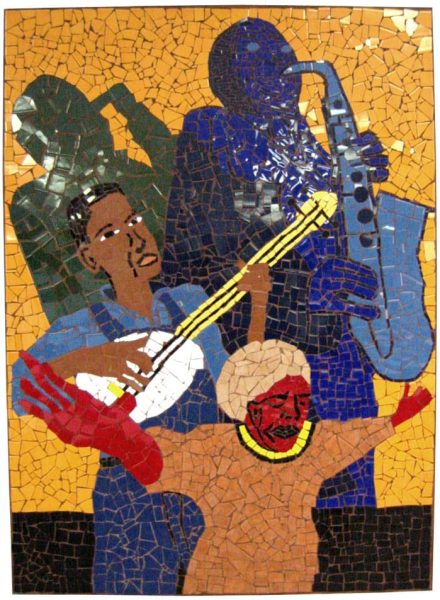
One of three mosaic panels created for Manley Career Academy High School in Chicago’s North Lawndale neighborhood, commissioned by the Chicago Public Art Group with support from Gallery 37 and the Mayor’s Office of Workforce Development. I led a team of nine community youth through the design and production of 66 square feet of public mosaic, assisted by Caswell James and advised by veteran muralist Nina Smoot-Cain.
This project is the direct ancestor of the School of Mosaic Environments. A detailed account of the project, written at the time, conveys how the learning experience included so much more than just mosaic technique. The methodology — community collaboration, intergenerational skill transfer, public art as civic investment — was developed here, in a high school in North Lawndale, two decades before the museum existed. The school already knows how to do this work. The MME gives it a permanent home.
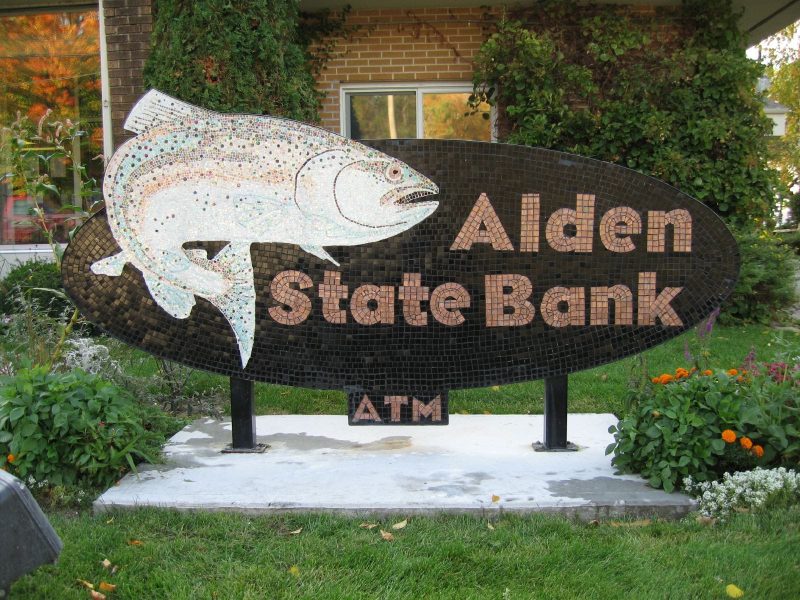
This sign was the down payment on my first house and studio, and the story of how it came to be is the story of how I have always worked.
I was leasing the buildings with an option to buy when heavy snow collapsed the studio roof as I stood on it, frantically shoveling. I leapt to safety. Most of the art and tools inside were destroyed. The collapse severed the gas line; it couldn’t be repaired until the ground thawed. I spent an entire Michigan winter without heat or running water.
When the bank came to assess the damage, they commissioned a sign instead. I built something spectacular out of the wreckage and got a house out of it.
I have been doing this my entire career: meeting disaster with creativity, turning setbacks into commissions, building forward when everything says stop. The Museum of Mosaic Environments is the largest version of that instinct I have ever attempted.
The MME is not a vision in search of a plan. It is a plan in execution, and it opens in stages.
The first stage is already underway: a touring series of immersive pop-up exhibitions, each one a full-scale, ticketed preview of the museum itself. The first opens in Valencia, a Mediterranean port city with one of the great living tile traditions in the world, a thriving cultural-tourism economy, and a legal framework that lets an institution like this one operate on its own terms. A pop-up is a real museum experience, not a placeholder: immersive mosaic environments you walk through rather than look at, several of them already complete, and the founding donor collection — hand-set tiles carrying the names of the people who built this — visible from the first day.
Each pop-up is also a working field lab for both the museum’s design and its business model. Attendance, revenue, press, and critical reception, measured city by city, decide where the flagship lands — a home chosen on evidence, not instinct. New printed environments debut with each deployment, refining exhibit design, lighting, visitor flow, and engagement with the content against real-world response before the museum commits to a full-scale build. Growing the permanent collection in public turns each pop-up into a preview of what the finished museum will hold, while keeping every showing new and fresh.
The flagship follows: a destination-scale building in Spain housing 30+ galleries across 9 curatorial arcs, from the earliest cone mosaics of ancient Mesopotamia through Byzantine sacred art, Islamic geometric tradition, the monumental public works of the twentieth century, and the contemporary artists pushing the medium into new territory. A 30-foot diameter mosaic map of the world — the museum’s first commission, designed by the founder and produced with mosaic artists in Spain — will present the global spread of mosaic across the cultures and continents that mainstream art history has systematically excluded. Adjacent to the galleries: the School of Mosaic Environments, a residency program for artists working in the medium, and a Visible Studio where the public watches the work being made. The MME is not a place you visit and leave. It is a place where the art form lives.
The MME is one founder-led institution, established in Spain as a Spanish SL in its current stage. It protects its independence through earned revenue and its own fundraising, and accepts no capital that carries governance influence. Financial independence is not a concession to capitalism. It is the only condition under which an institution like this one maintains autonomy.
We are in active development now: securing the first pop-up location, opening the seed-capital campaign, and completing the founding collection. The first pop-up is the campaign’s first milestone — fund it, and it opens, a real museum you can walk into within roughly a year rather than a decade. The work is already underway.
The Museum of Mosaic Environments will present the complete global history of mosaic art across 30+ galleries and 9 curatorial arcs, from the cone mosaics of ancient Mesopotamia to contemporary artists working in the medium today.
Every major cultural tradition is represented. Every gallery is designed as an immersive environment, not a display case. The visitor does not look at mosaic history. The visitor walks through it.
A full exhibition guide is in development. Follow our progress on Substack for curatorial updates as the program takes shape.
The Museum of Mosaic Environments is being built right now: outside institutional permission, outside federal funding, outside the structures that have historically decided which art and which artists matter.
If what you’ve read on this page moved you, there are two ways to stay close to what’s being built.
The seed capital campaign launches soon. When it does, every contribution, at any level, goes directly toward opening the first pop-up — the museum’s first doors — and the permanent museum it builds toward. You’ll hear about it first if you’re on the list.
In the meantime, the studio collection is available. Every work sold between now and opening day supports the move, the build, and the mission.